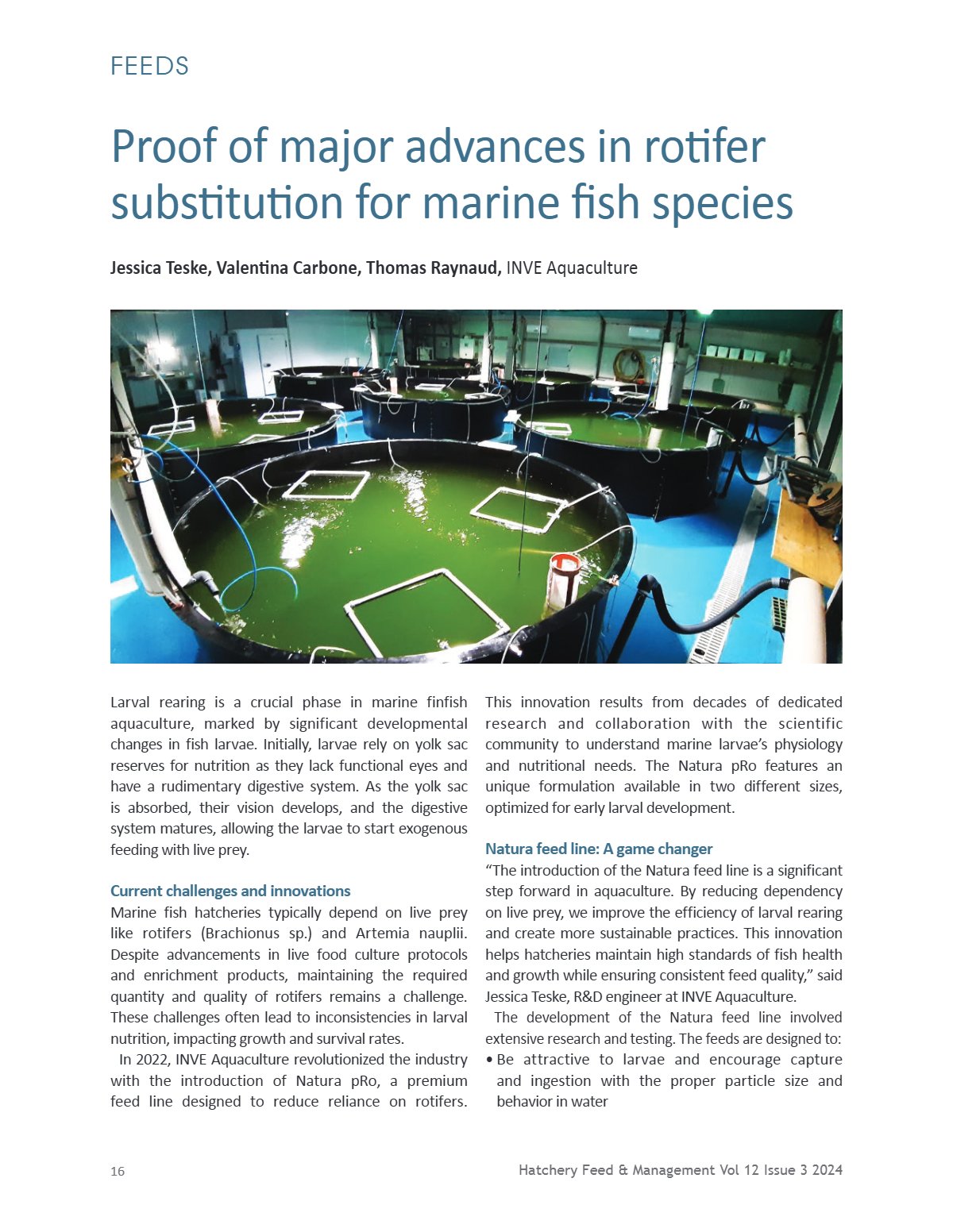
Larval rearing of marine finfish has historically relied on live prey like rotifers (Brachionus sp.), which presents substantial operational bottlenecks and nutritional inconsistencies. To reduce live prey dependency, INVE Aquaculture developed Natura pRo, an early larval microdiet formulated for early ingestion, assimilation, and digestibility. Across multi-species trials—including European seabass, gilthead seabream, barramundi, totoaba, snapper, and yellowtail amberjack—implementing early weaning protocols reduced rotifer consumption by 50% to over 80%, with up to 100% replacement in seabass reared under green water conditions. Larval survival at first grading remained comparable or superior to traditional live-food controls (e.g., reaching 65% in barramundi and 56% in totoaba). Fish growth and total length at grading were sustained across species, while population size homogeneity improved, significantly curbing cannibalism. Furthermore, deformity rates were lower or unchanged in weaned batches, proving that formulated early microdiets supply essential nutrients for skeletal development. These commercial validation trials demonstrate that strategic rotifer substitution enhances hatchery predictability, biosecurity, and cost efficiency in marine finfish aquaculture.